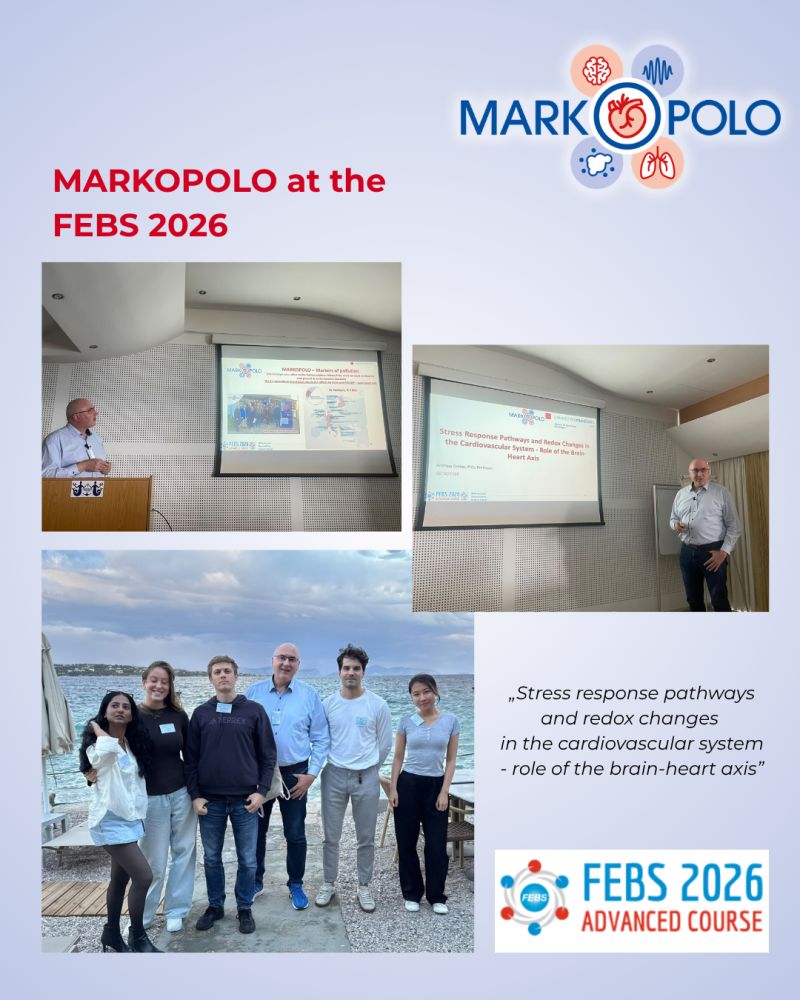
On October 2nd, our MARKOPOLO coordinator Andreas Daiber took the stage at the FEBS Advanced Lecture Course 2026 in Spetses, Greece, with the talk: “Stress response pathways and redox changes in the cardiovascular system – role of the brain-heart axis”. We are proud to see our project contributing to the international scientific community! 🌍
Author: Vanessa Köhler
World Heart Day: A healthy heart needs a healthy environment
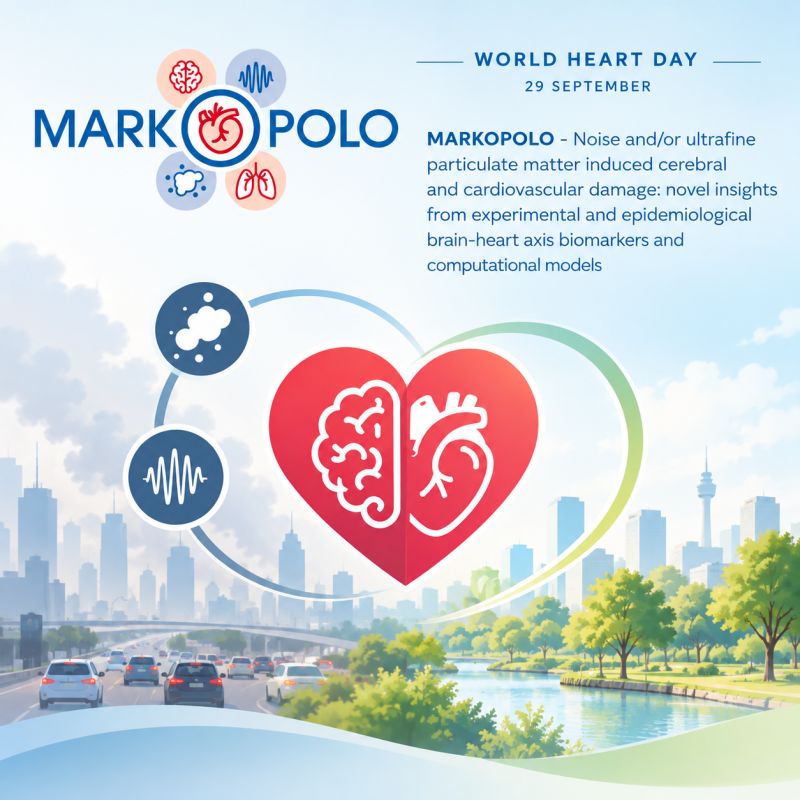
On World Heart Day, we highlight an often overlooked factor in cardiovascular health: the environment we live in. Air pollution, including fine and ultrafine particulate matter, and traffic noise are important environmental stressors that can affect our cardiovascular and brain health. Yet, their combined effects and the underlying biological mechanisms are not yet fully understood.… Continue reading World Heart Day: A healthy heart needs a healthy environment
Residential road traffic noise and incidence of depression in Denmark: a nationwide cohort study
Background: Evidence linking transportation noise to depression is limited. We investigated associations between road traffic noise at the most (LdenMax) and least (LdenMin) exposed façades and depression risk in Denmark. Methods: We established a nationwide cohort of 2,941,456 adults aged 25–65 years and for sensitivity analyses a nested questionnaire-based cohort, the Danish National Health Survey… Continue reading Residential road traffic noise and incidence of depression in Denmark: a nationwide cohort study
Lärm und psychische Gesundheit: Epidemiologie, Mechanismen und Handlungsansätze / Noise and Mental Health: Epidemiology, Mechanisms, and Interventions
Objective: This review summarizes current evidence on the effects of noise exposure on men-tal health and discusses psychological intervention approaches for individual coping. Methods: Narrative review based on a literature search in PubMed on noise exposure andmental health as well as intervention approaches, supplemented by expert knowledge and ad-ditional relevant literature. Results: Metaanalyses show an… Continue reading Lärm und psychische Gesundheit: Epidemiologie, Mechanismen und Handlungsansätze / Noise and Mental Health: Epidemiology, Mechanisms, and Interventions
MARKOPOLO at the Danish National Noise Day
Monday 28th September, Mette Sørensen presented new MARKOPOLO results at the Danish National Noise Day, showing the importance of having a quiet façade for protecting against noise-induced depression, to an audience of more than 150 key stakeholders, including officials from the Danish Ministry of the Environment, the Danish EPA, the Danish Road Directorate, local politicians,… Continue reading MARKOPOLO at the Danish National Noise Day
Acute co-exposure to urban particulate matter and aircraft noise elicits lung-centered immune-redox proteomic remodeling in mice
Particulate air pollution and transportation noise frequently co-occur, but their combined molecular effects are poorly defined. We used data-independent acquisition (DIA) LC-MS/MS proteomics to profile lung, brain, and heart from male C57BL/6J mice exposed for 3 days to NIST SRM 1648a urban particulate matter (PM), aircraft noise (NOISE), PM + NOISE, or control conditions. The… Continue reading Acute co-exposure to urban particulate matter and aircraft noise elicits lung-centered immune-redox proteomic remodeling in mice
Non optimal temperatures and chronic cardiovascular diseases
Extreme temperatures are emerging as major climate-sensitive drivers of chronic cardiovascular disease (CVD). Global warming has increased the frequency, duration, and intensity of heatwaves, while substantial cold-related risk persists, particularly in poorly insulated and socioeconomically vulnerable settings. Together, non-optimal temperatures account for millions of deaths annually, with a large and growing share attributable to CVD.… Continue reading Non optimal temperatures and chronic cardiovascular diseases
No pollutant acts alone: environmental co-exposure and the cardiovascular exposome
Environmental pollution is an important risk factor for cardiovascular disease. However, people are rarely exposed to a single pollutant. Air pollution, noise, heat, light pollution, chemicals, and micro- and nanoplastics often occur together and may interact to adversely affect cardiovascular health. This review highlights the concept of the environmental exposome, which considers the combined effects… Continue reading No pollutant acts alone: environmental co-exposure and the cardiovascular exposome
Aerosol oxidative potential and reactive species predicted with a chemical kinetics model (KM-OP)
Exposure to ambient air pollution is a major risk factor for human health yet, the physiological effects of particulate matter (PM) remain poorly understood. Oxidative stress due to excess formation of reactive oxygen species (ROS) is a leading hypothesis for the molecular mechanism behind the adverse health effects of PM. Thus, measurements of ROS production… Continue reading Aerosol oxidative potential and reactive species predicted with a chemical kinetics model (KM-OP)
The dark night as a cardiovascular vital sign: personal light exposure, subclinical cardiac remodelling, and the urban exposome
Artificial light at night is an increasingly widespread environmental exposure, but its potential effects on cardiovascular health are only beginning to be understood. In this editorial, MARKOPOLO researchers discuss new findings from a large UK Biobank study investigating the relationship between nighttime light exposure and heart health. The study included more than 11,000 participants with… Continue reading The dark night as a cardiovascular vital sign: personal light exposure, subclinical cardiac remodelling, and the urban exposome

Manage Cookie Consent
Functional
Always active
The technical storage or access is strictly necessary for the legitimate purpose of enabling the use of a specific service explicitly requested by the subscriber or user, or for the sole purpose of carrying out the transmission of a communication over an electronic communications network.
Preferences
The technical storage or access is necessary for the legitimate purpose of storing preferences that are not requested by the subscriber or user.
Statistics
The technical storage or access that is used exclusively for statistical purposes.
The technical storage or access that is used exclusively for anonymous statistical purposes. Without a subpoena, voluntary compliance on the part of your Internet Service Provider, or additional records from a third party, information stored or retrieved for this purpose alone cannot usually be used to identify you.
Marketing
The technical storage or access is required to create user profiles to send advertising, or to track the user on a website or across several websites for similar marketing purposes.